

If the screw air compressor is the lungs of an industrial plant, the rotor (or airend) is the heart. This precisely machined pair of helical screws-typically one male and one female-is the only part of the compressor that actually generates compressed air. Understanding the rotor's design, common issues, and maintenance can save your facility thousands in energy and repair costs.
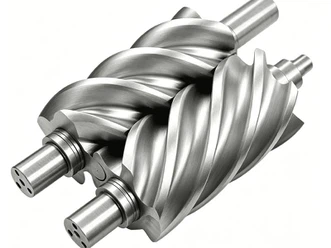
Male vs. Female Rotor: How They Work
A screw air compressor rotor consists of two interlocking helical screws:
Male rotor (drive rotor) : Usually has 4–6 lobes. Driven directly by the motor or gearbox.
Female rotor (driven rotor) : Usually has 5–7 grooves. Rotated by the male rotor via oil film contact or timing gears (in oil-free models).
Compression Process (4 Steps)
Suction – Air enters the inlet port as rotors unmesh.
Trapping – Rotors continue turning; the cavity seals off from the inlet.
Compression – As rotors mesh, the cavity volume decreases, compressing the air.
Discharge – Compressed air reaches the outlet port and exits.
✅ Key fact: 90% of volumetric efficiency depends on the rotor profile's sealing line and clearance design.
Critical Rotor Design Factors
1. Rotor Profile (Symmetric vs. Asymmetric)
Symmetric (older, rare): Simple but leaky – high energy loss.
Asymmetric (modern standard, e.g., SRM 'A' profile): Longer sealing line, 15–20% better energy efficiency.
2. Material
Cast iron with PTFE coating – Most common; good for oil-injected compressors.
Hardened stainless steel – For oil-free compressors (no lubricant means high wear resistance).
Coated rotors – DLC (Diamond-Like Carbon) or PEEK anti-friction coatings reduce wear in low-lubrication environments.
3. Clearance
Too large → internal air leakage → lower efficiency.
Too small → rotor seizure or coating damage.
Typical clearance: 0.02–0.08 mm (oil-flooded) / 0.15–0.25 mm (dry type).
Common Rotor Failure Modes
| Failure Type | Cause | Symptom |
|---|---|---|
| Rotor seizure | Loss of oil flow, overheating, or debris | Compressor sudden stop; metal debris in oil |
| Coating peeling | Acidic condensate or abrasive dust | Efficiency drop; high amp draw |
| Pitting/corrosion | Water in oil (low operating temp) | Rough rotor surface; rattling noise |
| End face wear | Bearing failure or axial load misalignment | Discharge pressure unstable |
5 Maintenance Tips to Protect Your Rotors
Monitor oil quality monthly – Water content >0.1% or viscosity change >20% means change oil immediately.
Keep air intake filters clean – One gram of dust per day can wear rotor coating within months.
Avoid short-cycling – Frequent starts/stops cause thermal expansion mismatch → rotor contact.
Check discharge temperature – Below 65°C risks condensation in oil. Above 105°C risks oil coking on rotors.
Use genuine replacement airends – Non-OEM rotors often have inaccurate profiles, killing efficiency.
When to Replace vs. Rebuild the Rotor
Rebuild (re-coating + grinding) – Cost ~30–50% of new. Good for minor wear or coating damage.
Replace – Required if rotors are seized, pitted deeply (>0.2 mm), or profile damaged. Also economical if efficiency loss exceeds 18%.
Efficiency Takeaway
A worn rotor can increase your compressor's energy consumption by up to 25% without any visible external sign. For a 100 kW compressor running 6,000 hours/year, that's potentially $12,000–15,000 in wasted electricity annually.


